5 min read
07 C "T-shaped" O
I was never comfortable with the CTO title.
CTO is one of the most overloaded titles in tech. In a startup it is often the first engineer - the young developer who built the prototype. In a large organisation it can be someone very far from the code, managing budgets and vendor relationships. The original idea was simple: bridge business and technology. But the title has been stretched so far it barely communicates anything specific.
The role has been narrowing for years. As companies matured, new problems demanded new specialists. CPO for product strategy. CDO for design and experience. CIO for internal systems. COO for operations. Each carved out territory that once sat under a single technology leader. The CTO that remained was often a more focused role - architecture, infrastructure, delivery - and in Germany especially, that narrower definition became the default. It is a different culture to Silicon Valley, where many CEOs and product leaders come from technical backgrounds. In Germany, leadership more often comes from consulting, finance, or operations, and that shapes expectations of the role.
I can do all of that. But it never fully defined me.
After my last CTO role ended, I found myself questioning the title for the first time. Not the work - I wanted something more customer-facing, closer to the business problems rather than the delivery machinery. I considered sales. I did advisory work. Eventually I built something on my own - product design, branding, growth, and engineering, all in one project. That was when the label stopped mattering and the shape underneath became clear.
I am technical. But I also care about product, brand, positioning, distribution, narrative. I have always been more T-shaped than boxed in.
T-Shaped
Deep in one discipline. Broad across many.
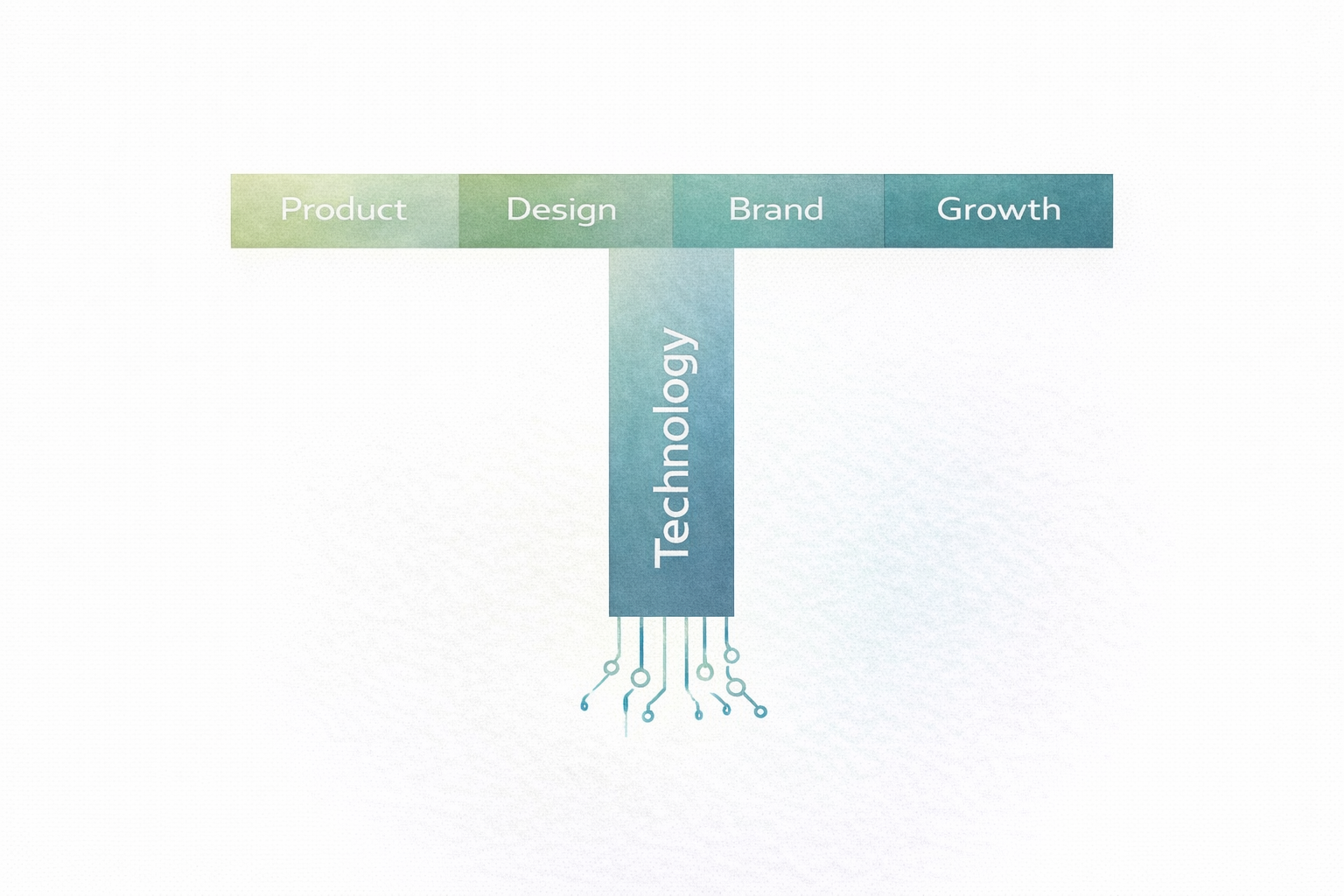
Most careers reward only the vertical. In AI product development, that assumption breaks. The hard problems are cross-functional by default.
Four Senses
This is the practical test I keep coming back to.
Product sense. The ability to identify the right problems to solve, prioritise ruthlessly, and make sound trade-offs. Understanding what is actually valuable.
Design taste. Recognising what good looks like - simplicity, clarity, low friction. Starting from the problem, not the interface.
Marketing sense. Understanding growth loops: how users discover, share, and spread products. Knowing that distribution without retention is noise.
Engineering sense. Technical intuition for what is feasible, what is expensive, and what creates real defensibility. Knowing which problems are deterministic and which are not - and whether AI belongs in the product or only in the process of building it.
These are not four departments. They are four lenses every material decision should pass through.
Failure Modes
When teams are deep but narrow, the same problems show up:
Feature success, product failure. Engineering ships what was asked, but the user job was wrong.
Growth success, retention failure. Distribution works, but activation and value do not hold.
Demo success, operational failure. The prototype looks convincing, but cost, reliability, and governance collapse in production.
None of these are solved inside one function. They are coordination failures. I have seen every one of them from the inside.
T-Shaped Teams
This is not just a leadership model. It is a team design principle.
Consider a product team building an AI feature. The PM needs enough engineering sense to know whether the feature genuinely needs a large language model or whether traditional software would be cheaper and more reliable. The engineer needs enough marketing sense to understand whether the output is shareable - because a feature nobody talks about is a feature nobody discovers. The designer needs enough product sense to know which jobs-to-be-done matter most, not just which interface looks cleanest. The marketer needs enough technical literacy to understand token economics and cost trade-offs before promising scale.
This is not an argument for everyone becoming a generalist. It is an argument for designing deliberate overlap. If you skip it, the cost is predictable: rework, false velocity, and strategy that looks coherent in slides but fractures in delivery.
It also means recognising where your own gaps are. T-shaped does not mean pretending to cover everything. Good operators know when to bring in people who are stronger in a specific lane. AI helps with range, but it does not remove that judgement.
The Convergence
AI collapses boundaries. Product is technical. Technology shapes product. Design shapes both.
Code is increasingly commoditised. AI handles pixel-level design production well. It generates prototypes, layouts, variations. Everyone can design now - or at least produce things that look designed.
And that is precisely the irony. At the exact moment AI makes design production accessible to everyone, the need for a strong design voice at the leadership level becomes more urgent, not less. When anyone can generate a prototype, the hard question is no longer “can we build this?” It is “should this exist, and does it feel right?” Brand coherence, interaction quality, the decisions about what a product should feel like - these are not production problems. They are judgement problems. And in most companies, design still does not have a seat at the table where those decisions are made.
AI raises the floor of the horizontal bar - giving everyone access to competence across disciplines they are not deep in. Which makes the vertical bar, your real depth, even more valuable. AI makes breadth easier and depth more important at the same time.
Titles matter less than integration. The best leadership teams I have seen are composed of T-shaped leaders who overlap deliberately rather than defend turf.
If your thinking is vague, AI exposes it. If your architecture is weak, AI collapses under it. If you are disciplined, AI accelerates you.
This is not a CTO argument. It is not even a leadership argument. T-shaped skills have never been more important for everyone building products - regardless of title, seniority, or function. The people who thrive in what comes next will not be the deepest specialists or the broadest generalists. They will be the ones who go deep enough to be credible and broad enough to be useful.