9 min read
11 Do You Read Me?
We're trading one kind of competence for another, and we don't yet know the exchange rate.
A friend told me recently that she was going to throw one of my blog posts into ChatGPT. Let’s be honest, some of my posts are very long and technical. She is not a native English speaker. Most of my friends are not - I have lived in Germany and Spain for nearly seventeen years. Her instinct was practical: get the AI to pull out the main points, skip the parts where the language slows her down.
I understood. And it bothered me.
Not because she was being lazy. Because what comes back from that transaction is the information without the texture. The sideways way I arrive at a point, the rhythm of a sentence that earns its conclusion, the personality in how something is said - the AI will translate the meaning and flatten the voice. She will know what I said. She will not know how it sounded.
There is a bookstore in Berlin called Do You Read Me? on Auguststrasse. Curated magazines, independent publications, beautiful design objects. I have walked past it dozens of times. I have never bought a book there.

I read fewer books than I used to.
I always assumed I had perfect eyesight. In my mid-forties I started needing glasses. Before I was diagnosed, I did not understand why I was less drawn to screens, less inclined to read, less patient with code. I assumed it was attention. It was not. It was my eyes, making choices my brain had not caught up with. I still do not wear them in public. I only put them on at my desk, in front of a screen. The morning fog when I check my phone without them. The blur after a few drinks. These are the moments when reading quietly stops being something you choose and starts being something you avoid.
I miss reading.
I cannot blame my friend for doing the same thing I do.
The Summary Is Not the Thing
People paste articles into ChatGPT now. “Give me the key points.” They get the key points. They move on. They got the information. They missed the experience.
A twelve-minute essay is not twelve minutes of information. It is twelve minutes of atmosphere, rhythm, hesitation, misdirection, and the specific way a writer arrives at a point. The summary strips all of that. You are left with a skeleton and you think you saw the body.
And then there is the other side. AI is not just summarising - it is generating. The clue is in the name. GPT - Generative Pre-trained Transformer. It generates. So many words. So little being said. We are simultaneously losing the patience to read and flooding the world with things not worth reading.
You read a headline on Facebook about the next unmissable show on Netflix. You click through. You scroll past the ads, the related articles, the autoplay videos. Three minutes later you still cannot find the name of the show. The name could have been in the headline. But it was not. Your attention is the product. The content is just the bait. The dopamine hit of extraction is real. The blind spot it creates is harder to see.
Typing. Speaking. Thinking.
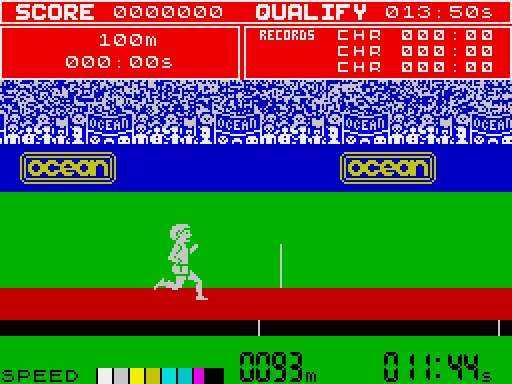
In 1984, to make Daley Thompson run on a Sinclair Spectrum , you hammered two keys back and forth as fast as your fingers could move. There was no mouse. There was no joystick. Just a rubber keyboard, blisters, and friction. That was the interface.
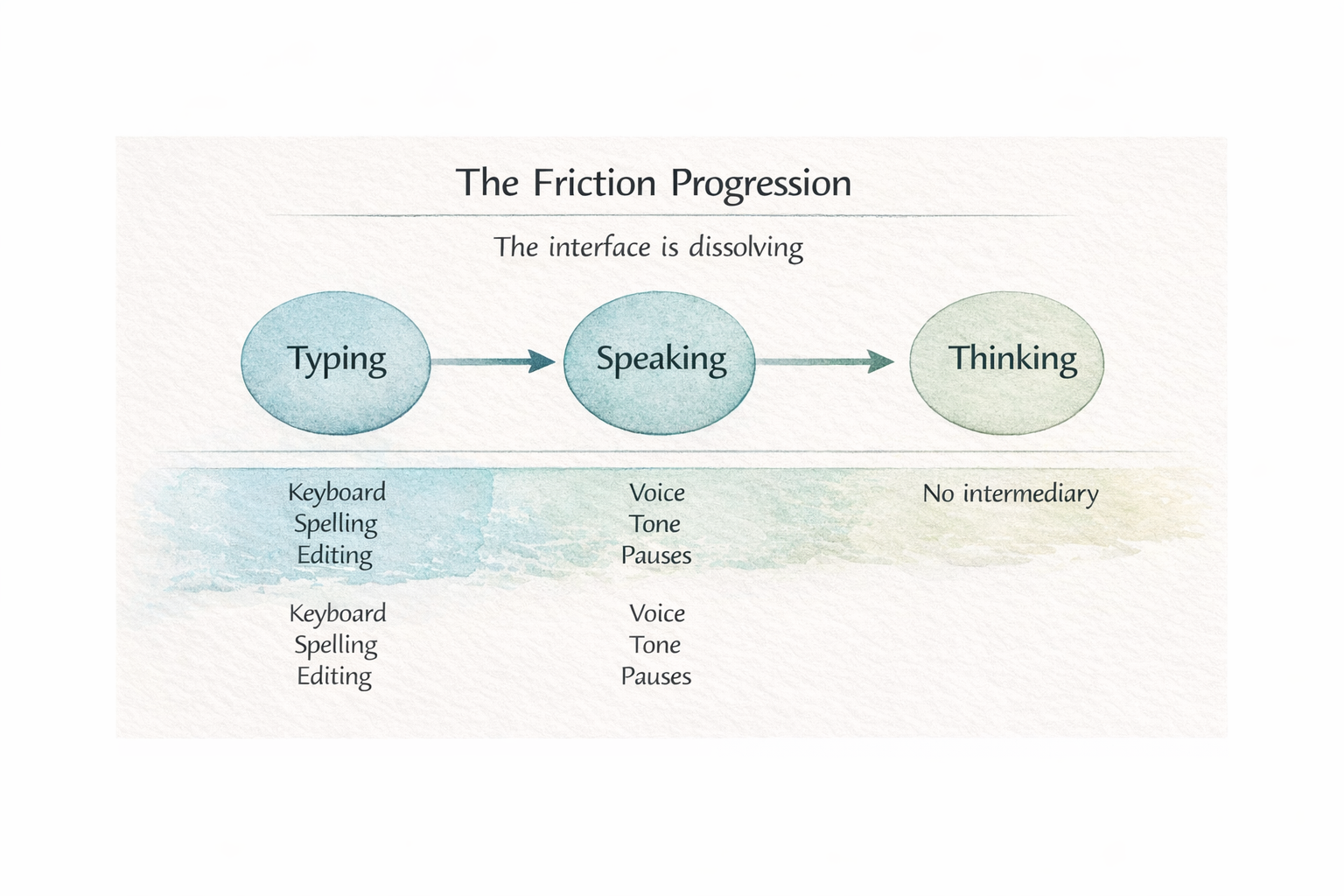
I use Wispr Flow now to speak to AI when I am coding. No keyboard. No spelling mistakes. I talk, it listens, it organises. It captures nuance that typing filters out - the digressions, the way I circle a problem before committing to a solution. A friend, Malte Wagenbach , built Whisper to solve the same problem without the cloud - voice processed locally on your Mac, data immediately discarded. Different philosophies, same instinct: the keyboard is no longer the interface.
It is genuinely better. The feedback loop is faster. The friction between having an idea and expressing it is nearly gone. I used to code the same way - slowly, deliberately, solving problems one at a time, getting the adrenaline rush of being stuck and then unstuck. That contemplative rhythm is gone now. AI agents accelerated the work, but the expectations scaled with them. It is still satisfying. It is not relaxing.
A former colleague, Artur Roszczyk , wrote about this in his piece Slow-code . He describes feeling disconnected from the code he commits. His remedy is deliberate: editor only, word by word, no AI. He is one of the strongest proponents of AI-assisted coding I know. But he is also a professional choosing to maintain a relationship with the material.
The progression is clear. We went from typing to speaking. Elon Musk’s Neuralink is working on the next step - thinking directly into the machine, no speech required. Noland Arbaugh , the first human trial participant in 2024, controlled a computer with his thoughts. The interface is dissolving.
Each step removes a barrier between intention and action. Each step also removes a filter - a space where you pause, reconsider, choose your words. The friction we are racing to eliminate might be the space where something important happens.
The Integrity Problem
There is a quote, attributed variously to Naval Ravikant , Gandhi, and others:
Integrity is when what you think, what you say, and what you do are one.
It sounds aspirational. Align your actions with your beliefs. Close the gap.
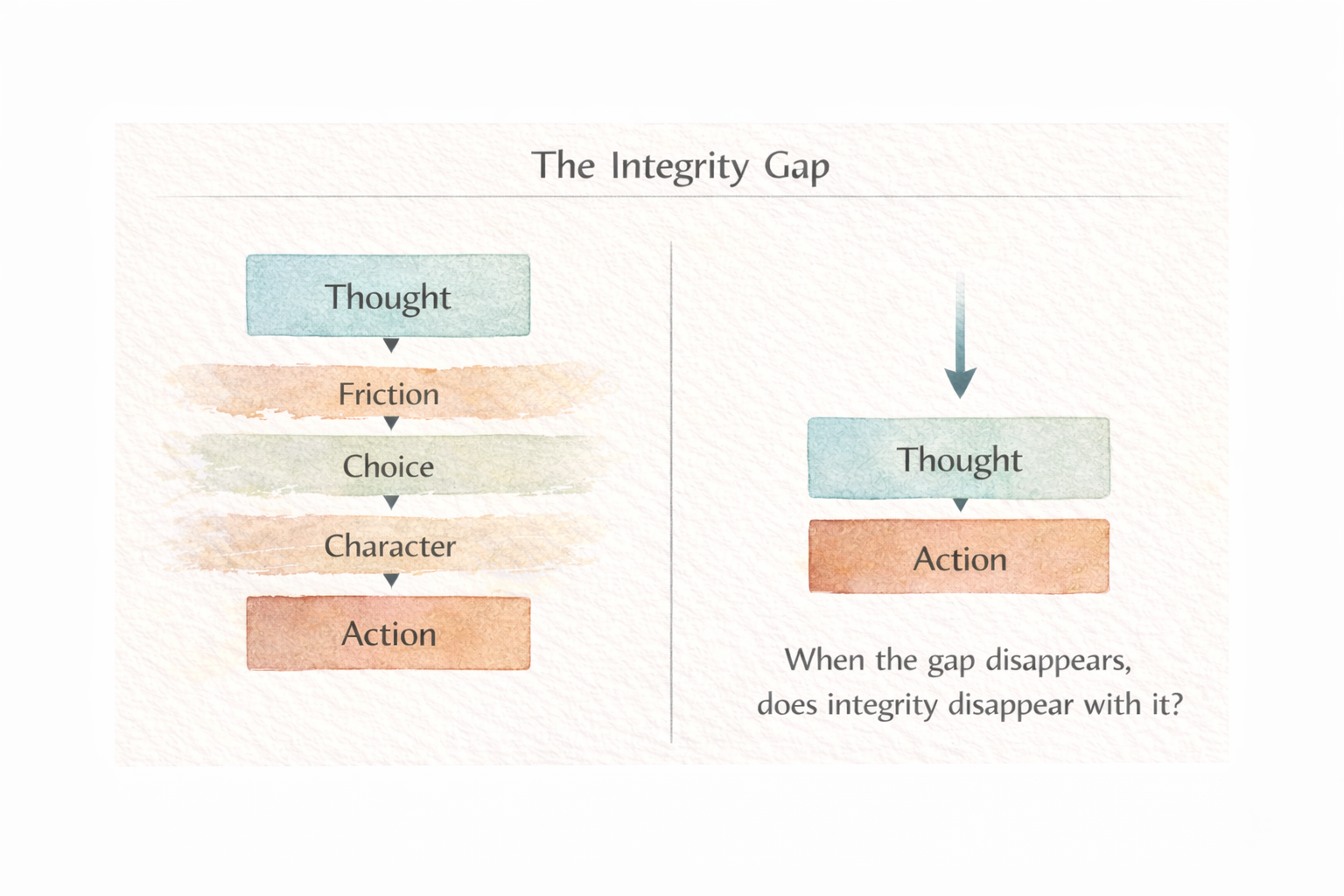
But integrity only exists because there is a gap. It requires a space between thought and action where you choose to be consistent - or choose not to. That choice is the moral act. If technology collapses the distance to zero - if thought becomes action with no intermediary - there is no choice involved. You are not being honest. You are just being fast.
The same friction we are racing to eliminate is the space where character lives.
What Lived in the Gap?
Dick Guindon wrote:
Writing is nature’s way of letting you know how sloppy your thinking is.
The slowness of writing was not a limitation. It was the diagnostic.
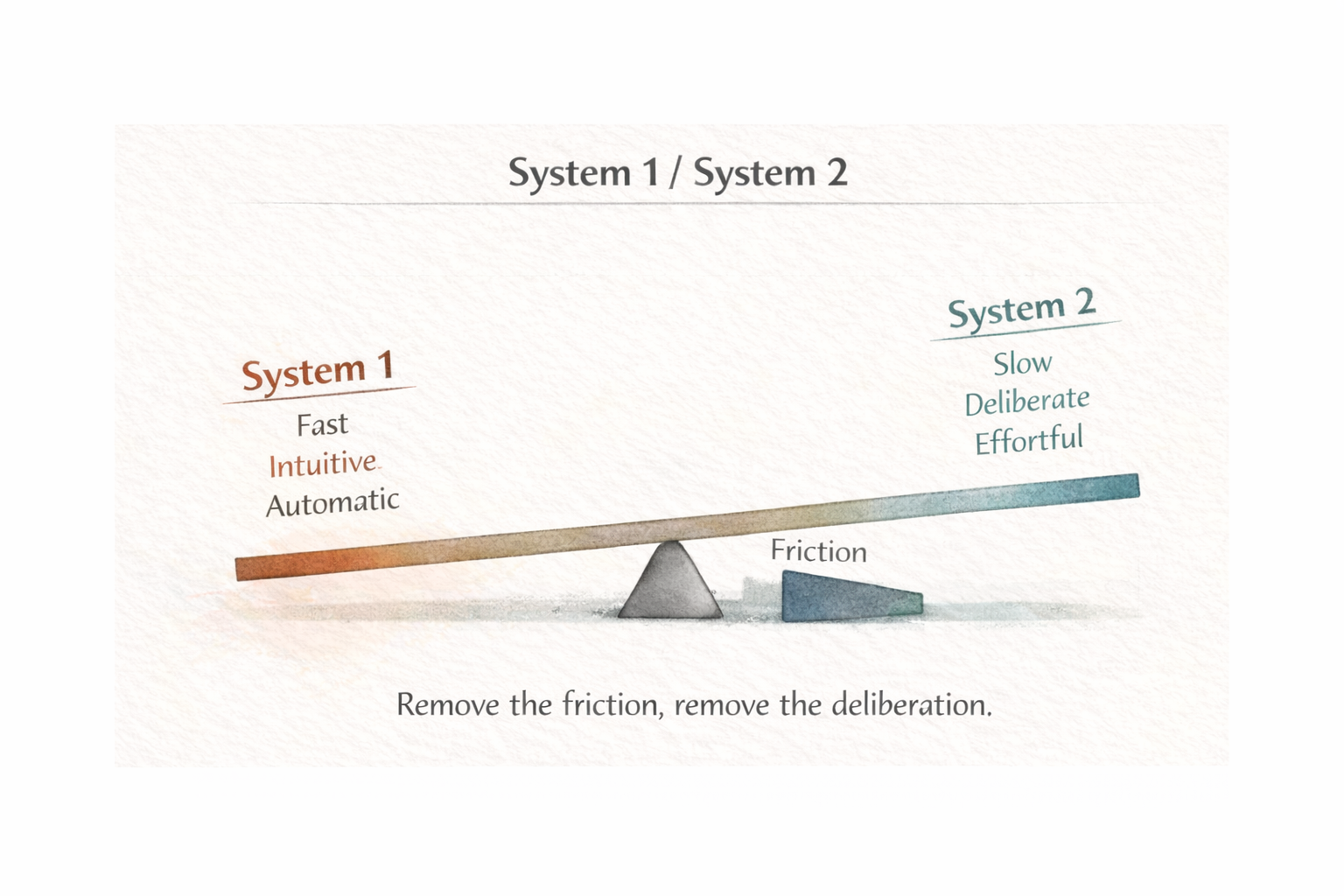
Daniel Kahneman described two systems of thought. System 1 is fast, intuitive, automatic - the lizard brain , the amygdala, fight or flight. System 2 is slow, deliberate, effortful - the prefrontal cortex, the part that pauses before acting. System 2 is where critical reasoning lives. It is also the part that therapy strengthens: the space between stimulus and response where you learn to respond instead of react.
Every layer of friction we remove pushes more activity toward System 1. When thought goes straight to action, you are running on instinct with machine amplification. We are building tools that route around the very part of the brain that makes us deliberate.
Heidegger had a word for it. When a tool works perfectly, it becomes invisible - ready-to-hand. You do not think about the hammer. You think about the nail. But when the tool breaks or surprises you, suddenly you are aware of it again. The friction is what creates awareness. Remove the friction, remove the awareness.
The Counterargument
Here is where it gets interesting.
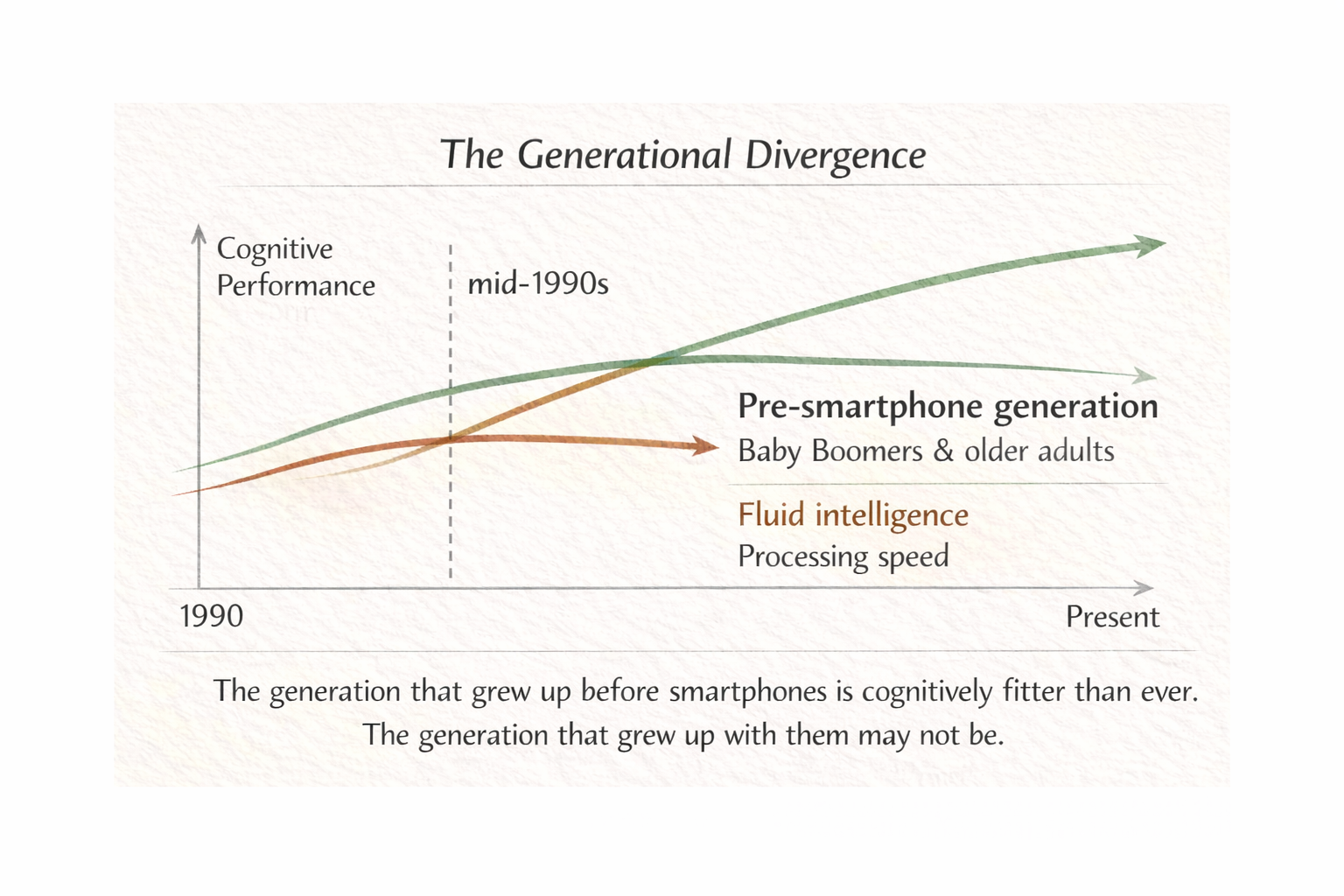
Researchers at the Max Planck Institute in Berlin compared 75-year-olds tested in 2010 with 75-year-olds tested in 1990. The recent cohort outperformed the earlier one by 1.2 standard deviations - the equivalent of 25 years of cognitive advantage. A meta-analysis from Nottingham Trent University in 2024 found that 68% of cognitive measures showed improvement in later cohorts of older adults. Dementia incidence is declining across high-income countries.
Technology is not making older people dumber. It appears to be making them sharper.
But the same data contains a warning. The Wisconsin cohort study found that the cognitive gains peak with Baby Boomers and plateau - or possibly reverse - with Generation X. Multiple countries show IQ scores declining in younger populations from the mid-1990s onward, concentrated in fluid intelligence: reasoning and processing speed. The very capabilities that deep reading and slow thinking develop.
The generation that grew up before smartphones is cognitively fitter than ever. The generation that grew up with them may not be.
The New Division of Labour
I still remember my sister’s phone number in Brooklyn. 718-998-832X. I memorised it in 1995 because I had to dial it into a phone box. I recently got a Spanish mobile number. I do not know it. My own number. I have to look it up in my contacts.
GPS made us worse at navigation. Spell-check made us worse at spelling. Phone boxes made us remember numbers. Remove the friction, remove the capability.
But then I think about Mahmoud . He was a colleague at Future Demand , an AI startup I worked at just before COVID. He had no patience for books or manuals. He learned by fast-forwarding through YouTube videos. He did not care about SSL certificates, Let’s Encrypt, or CDN configuration. He just wanted the server deployed, the problem solved, and to move on to something bigger.
When I met Mahmoud again about a year ago, he was the most advanced ChatGPT power user I had seen. AI removes every friction he was fighting against. He never needed the manual. He needed the outcome.
Or maybe something is lost when you skip the manual. We are trading one kind of competence for another, and we do not yet know the exchange rate.
Can You Hear Me, Major Tom?
If you made it this far, you are the exception.
Most people will not read this. They will scan the headings, maybe paste it into an AI, get the summary. They will know what I said. They will not know how it felt to say it. They will not know about the bookstore I have never bought a book from, or the glasses I will not wear in public, or the phone number I can still recite from a phone box thirty years ago. They will get the points. They will miss the person.
That is the question the bookstore asks, every time I walk past it.
Do you read me?